Four Perspectives
This bill sits at the intersection of gender justice, federalism, electoral strategy, and constitutional process. Click each perspective to explore.
1Women's Representation
India ranks 143rd of 190 countries in women's parliamentary representation. The 106th Amendment (2023) promised one-third reservation but tied it to a future census — effectively making it contingent on an event that hadn't been scheduled.
This bill breaks that deadlock. By allowing delimitation based on the latest published census, it makes women's reservation actionable before the 2029 elections.
The counterargument: women's reservation could have been implemented within the existing 543 seats, without tying it to seat expansion or delimitation. The 106th Amendment's original design — linking reservation to a new census — was deliberate.
2Federal Balance: North vs. South
For 50 years, a constitutional compact ensured states that controlled population growth would not lose political power. Southern states — Tamil Nadu (TFR 1.8), Kerala (1.8) — invested in family planning. Northern states — UP (2.4), Bihar (3.0) — did not achieve the same results.
Under pure population-based allocation using 2011 data at 816 seats:
- Tamil Nadu's share of Parliament drops from 7.2% to 5.8% — a 19% reduction in influence
- Kerala's share falls from 3.7% to 2.7% — a 27% reduction
- UP's share rises from 14.7% to 15.6%
Whether this is "fair representation" or a "population penalty" depends on your theory of federalism. Try the simulator yourself →
The government's response: proportionate increase
PM Modi stated on April 5, 2026 that "states that stabilised population will not lose Lok Sabha seats in delimitation." Home Minister Amit Shah has assured party representatives that the Lok Sabha's strength would increase by 50%, "distributed across states in their existing proportions." Under this model, every state gets ~50% more seats — no state loses its current count.
Congress leader Jairam Ramesh called this "deliberate deceit," arguing that even a proportionate increase disadvantages the South because:
- Proportions may stay the same today, but the bill permanently delegates census choice to ordinary law — a future government can switch to population-based allocation at any time
- The absolute gap between North and South widens (UP goes from 80 to 120, TN from 39 to 59 — the gap grows from 41 to 61)
- The proportionate model is a verbal assurance, not law — the bill text itself says "on the basis of such census" and "by the Delimitation Commission," not "in existing proportions"
What would it take legally?
For a proportionate increase to be constitutionally guaranteed (not just a political promise), one of the following would be needed:
- Option 1: Amend Article 82 to specify that seat allocation must maintain existing state-wise proportions when the house is expanded. This would require a constitutional amendment with state ratification.
- Option 2: Include a proportionality clause in the Delimitation Bill, 2026 (the companion ordinary legislation). This could be done by simple majority but could also be overturned by a future simple majority.
- Option 3: Direct the Delimitation Commission via its terms of reference to maintain proportions. This is an executive action, not legislative, and can be changed by the next government.
Currently, the bill uses language ("on the basis of such census") that points to population-based allocation, not proportionate scaling. A proportionate model would need explicit language like "in proportion to the existing allocation" — which is absent from the bill text.
3Constitutional Process
Currently, the choice of which census determines seat allocation is embedded in the Constitution (Articles 81, 82, 170). Changing it requires a constitutional amendment: two-thirds majority plus ratification by half the state legislatures.
The bill replaces "the last preceding census" with "such census as Parliament may by law determine." After this passes, the census choice becomes ordinary legislation — simple majority, no state ratification.
This is a one-way change. Future governments can pick whichever census suits them without amending the Constitution again. The same structural change also affects SC/ST reservation (Art. 330) and Presidential election vote weighting (Art. 55).
4Future Governments & the Delimitation Commission
This bill doesn't directly allocate seats. It creates a framework: a Delimitation Commission (chaired by a Supreme Court judge) will draw boundaries. Its orders have the force of law and cannot be challenged in court.
The critical question is what happens after this bill becomes law:
- Any future government can choose which census to use — by simple majority
- The 850-seat cap is a ceiling, not a mandate — the actual number is decided later
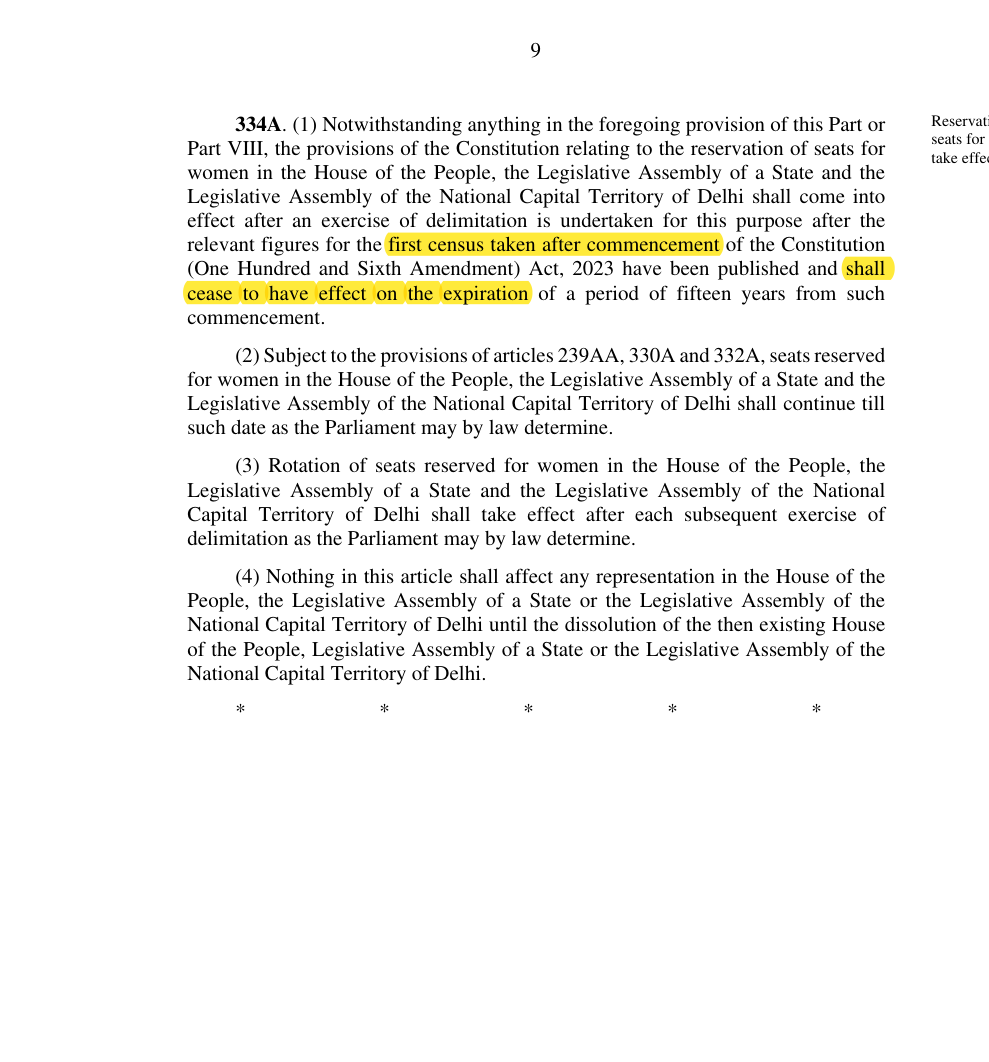
- Women's reservation expires 15 years from 2023 unless Parliament extends it
A different government in 2034 could choose a different census, resize the house, or let women's reservation lapse. The bill creates the mechanism; politics determines how it's used.